Monday, October 12, 2015

Five years: Stuff happens

This weekend marks five years since I was working at my job in the South Pacific territory of American Samoa and had a seizure that announced unequivocally that something was wrong with my brain’s wiring. Ten days later, after an emergency medical evacuation to Auckland, New Zealand (the “nearest center of medical excellence”), I was diagnosed with a tumor on my right frontal lobe.  Emergency brain surgery and a six-week course of radiation soon followed.

By all accounts, I’ve thrived over the intervening years, with no new tumor growth. I am nurtured, supported, and encouraged by family and diverse, ever-widening circles of friends, and I do my best to nurture, support, and encourage them all in turn. I have a job that pays me enough to occasionally buy frivolous things like dahlias at the farmers’ market just because it’s a gloomy day. I snuggle with my cats and read good fiction and watch some clever (and some dumb) TV shows and look at praying mantises in my garden and play Macklemore’s “Downtown” on repeat at high volume. I travel to new distant countries and traipse around museums and ruins every chance I get.

This "anniversary" weekend has been wonderfully full: cheering on my daughter at a martial arts tournament, laughing and drinking beers around a campfire, walking on the beach, getting ice cream and paletas as a reward for a long bike ride. Spotting herons in marshes. This is the life I have with the people I love. Five years out, I rarely envision my dying self hooked up to morphine in a hospice, although that day may well come.

But increasingly, especially at large public gatherings, I envision gun violence. I fear that someone I care about, particularly my daughter, will be in the wrong place at the wrong time, having the gall to go about what should be an everyday routine of attending school, or church, or shopping, and all of a sudden the day, and that life, ceases to be routine forever. 

I let my beloved girl bike alone around our neighborhood but pause when I drop her off at the roller rink to attend a birthday party. It’s a place characterized by squealing children and blaring pop music competing with laser tag and disco lights and the pings and bonks of arcade games. 30,000 square feet with no windows, staffed entirely by teenagers. It’s the kind of venue where, increasingly, I expect an angry man with access to a personal arsenal of firepower will choose to enact his deranged version of vengeance on a bunch of unsuspecting people before anyone even realizes what is happening.

Certainly, I never expected that at 39 I’d be diagnosed with brain cancer. Of course, I never expected that as a citizen of the US, I’d see repeated gun massacres in public spaces. In churches. In malls. In movie theatres. In fucking elementary school classrooms.
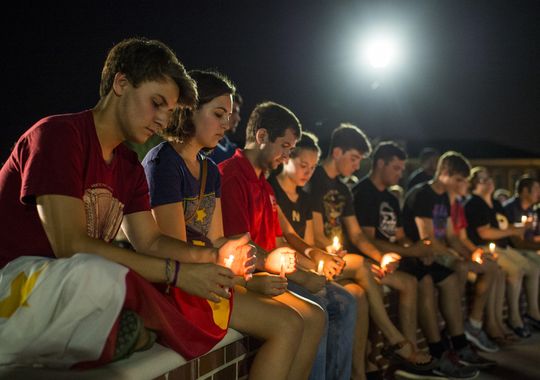
Candlelight vigil, Lafayette, LA

Despite how unfortunately common cancer of every type is, we always look upon someone’s diagnosis as a surprise, something that couldn’t have possibly been anticipated, despite a person’s individual risk factors. For far too long, we’ve treated the risk of gun violence the same way: something unexpected. But gun violence and mass shootings have become anything but a surprise. Spend a few minutes looking at this chart from The Guardian and you will probably realize, as I did, that mass shootings – let alone the many instances where fewer than 4 people are killed or injured – are now so sickeningly common that you probably weren’t aware of most of them. Such violence is now a routine, nearly everyday occurrence, as President Obama reminded us after the violence in Oregon.

Candlelight vigil, Roseburg, OR

Cancer has certainly taught me that death is inevitable, whether from bad decisions or fluke accidents or old age or rogue cells that divide and host intruders. Stuff happens. Yet while my brain tumor wasn’t predictable, many cancers ARE considered preventable, and so we tackle cancer risk, by screening, vaccinating, wearing sunscreen. We put mandatory warning labels on packs of cigarettes and aerosol cans and alcoholic beverages. We acknowledge that there is compelling evidence that certain substances and exposures are more likely to increase the chance of getting cancer.  

Cancer exists in nature and is not a strictly human creation, but we recognize it as a public health risk and devote intensive resources to its prevention. Guns don’t occur organically, and are purely designed and used by humans.  And still we fail to identify them as a public health crisis.

Prayer vigil, Charleston, SC

 Several days before I finished my course of radiation in early January 2011, former US Representative Gabrielle Giffords – we are nearly age peers – was shot in the head as part of a mass shooting that took the lives of six and wounded twenty. A couple of weeks later, I remember watching the nightly news with dear friends at their home in Auckland, talking about the shooting, and realizing with irony how fortunate I was. I only had brain cancer, a function of the great, often baffling mystery of the world. A fellow human didn’t decide to shoot me in the head. Brain cancer had thus far spared my speech and motor skills, unlike what Jared Loughner’s gun had done to Gabby’s brain.

Candlelight vigil, Tucson, AZ

I thought hard about my mortality the night before my brain surgery. It’s a terrifyingly deep well, one I am grateful not to have fallen into yet. Too many others suffer and die violently from guns before they even have the privilege of contemplating their lives.

This is not simply a call to carpe diem and tell people you love them. (Although do that too.) Five years ago and at every subsequent MRI and oncology appointment, friends and family across the globe, from many different cultures and faith traditions, have lifted me up in prayer and demonstrated what is good and unifying in the world. I am ever grateful. But right now, I want to ask for a different kind of support, one that requires more than bowing your head or lighting candles, like the grieving people in these photos attending vigils in the wake of gun violence. Those are good and worthy actions, but rather than simply celebrating my 5-year milestone, please, do something to promote gun control in America.

Call your elected officials. Attend rallies in support of reasonable gun control laws. Donate to one of the many organizations fighting the uphill battle against the NRA and its elected puppets at every level of government, including:

Everytown for Gun Safety/Moms Demand Action (http://everytown.org/)
Americans for Responsible Solutions (http://americansforresponsiblesolutions.org/)
Sandy Hook Promise (http://www.sandyhookpromise.org/)  

And if you think I’m way off base, that gun violence isn’t the issue, mental health is, then for God’s sake, take some action on that. Donate to the National Alliance for the Mentally Ill (https://www.nami.org/) or one of those good organizations in your neck of the woods that serve those with mental health problems.

“Stuff happens,” Jeb Bush told listeners at a campaign event in South Carolina the day after the Oregon shooting. Five years since my diagnosis, and I’ve always shied away from identifying myself as a survivor, perhaps because a good chunk of the tumor still lives in my skull. But I think our collective survival as Americans depends upon reclaiming the narrative about guns.

I am not naïve enough to think that we can eliminate all gun deaths, but I do think we can take reasonable steps – perhaps mandatory background checks and waiting periods for purchasing, a national gun registry, liability insurance for legally purchased guns, and closing purchasing loopholes – to limit angry people from getting and using guns, and in doing so, take our country back from those who have us cowed into submission and inevitable future gun violence. This kind of stuff doesn’t have to happen.
  
[Note: I hadn’t even finished my final draft of this essay – begun on October 1, 2015 after the Umpqua Community College shooting - when I heard the news of yet another mass shooting on October 9, 2015 at another campus, this time Northern Arizona University in Flagstaff, AZ.]

Sunday, December 21, 2014

Winter Solstice 2014


It has been a year of transition, although even saying so sounds cliché. Is there ever a year without transition? 2014 was marked by a false start, to use a running metaphor, apt considering that we were to be in western Kenya this year, one of the world’s running capitals, a place I fell hard for, even as it was almost immediately clear that my job there was all wrong.

The year’s synopsis: I quit a job. I looked for a job. I found a new job. There were growing pains: a farewell to academia; an adjustment to corporate regulations and oversight. My wife left her own business and went back to school. There were growing pains: instructors who didn’t really teach; arbitrary exam questions. Our daughter started her final year of elementary school. There were growing pains: a flight by herself that she was sure she wouldn’t survive; a week of sleepaway camp; plans for middle school. We all survived.

Too often this past year the world itself felt unmoored, like we collectively wouldn’t survive, and I haven’t always been sure, these past months, with gun violence and a literal plague and fear and incivility and racism, how we continue, as a species, to light the candle. 

I just finished Emily St. John Mandel's Station Eleven, a post-apocalyptic novel about how the world forges on after life as we know it has ended, how one can and should find grace and gratitude in everyday life. It is a deeply humane work, and so on this, the longest night, the winter solstice, I want to catalogue some of my many blessings this year. 
  
The homeless man who serenaded me with “Love Me Tender” after a group of us from the Unitarian Church had served dinner to him and his fellow shelter residents. Did we like Elvis? he asked us. Yes, I said. The discovery, last spring, in my regular morning rambles during my months of underemployment, that Northern Flickers had made a nest in a dead tree along the bike path. Finding out I have a Kenyan namesake and knowing that, despite whatever else happened during my long January in Eldoret, I will always be anchored to that place and that little boy.

The botanical gardens at my alma mater, riotous and tropical. The friendly old security guard at the MFA Boston, a Navy vet from WWII, with whom I swapped stories when I sat down to give my blistered feet a break after a job interview. Finding shards of antique pottery on the beach, a robin’s eggshell on a walk. Black raspberry ice cream cones after swimming in the ocean; baby praying mantises hatching in our neglected garden. The wonderful vintage sign I “rescued” from the front yard of a long-abandoned antiques store that now hangs in my den. Meeting my favorite band (Lucero) at the Newport Folk Festival and finding out that they're not just hard-drinking, tattooed womanizers. (Or at least they're really polite ones.) A butterfly bush I “rescued” from a construction site that eventually bloomed in my yard. 

Dahlias. Oh, the dahlias, at the farmers’ market; at our dear ones’ beach house in Weekapaug; for sale, $2 a stem, along a rural road. Stevie Wonder in concert, and singing along to "Sir Duke" with thousands of others. The Georgian doors and fanlights of Dublin. standing on the site where Handel’s “Messiah” was first performed in 1742 and honoring that work by singing a few bars of “O Thou That Tellest Good Tidings to Zion,” my favorite piece from that oratorio.

“O Thou...” is in 6/8 time, and those who know me well are aware that I have an unusual affinity for this time signature, that indeed I can pick it out from the merest background Muzak in a store. That “O Thou” is what I willed myself to hear the rhythm of as I was emerging from anesthesia after brain surgery a little over four years ago, and how, when I could still count it in my head, I knew that I would be okay. Blessings then. Blessings now.

Most of all, the blessings of connection this year. The broad and lovely way that I define family, my parents, my wife and daughter and my daughter’s father and his parents and sisters and my sister and her family and my father-in-law and my brother-in-law and his family. The friends so dear that they are aunties and uncles and cousins to my daughter, family in spirit if not law. The pals from my happy childhood in a close-knit town, many of whom I was able to reminisce with at my 25th high school reunion; my beloved colleagues and students at Brown; my new compatriots at work who crack wise with me; our church communities; the good people at the kung fu studio; the women from Smith who remind me how each one of us is still finding her way; the fellow parents who make us laugh and pinch hit as babysitters and whose families we adore. So many connections, sometimes in person, sometimes epistolary, sometimes only briefly after years, sometimes merely on social media but not, as critics would have it, meaningless. So many beloveds, everyone with their own struggles and moments of clarity. I am grateful for you all.

Merry Christmas, and Happy New Year. Keep lighting the candle.

Namaste,
Kelley

Lyman Plant House, Smith College


Baby Mantis
Pottery shard, robin's egg


"Rescued" sign

Dahlia, Green Animals Topiary Garden


Roadside Dahlias


A Dublin Door


Parents, nephews, daughter


Me and Sis


Me with Ben Nichols (swoon!) of Lucero at Newport

Dad and the girl

Me and the folks


My girls

Dad and Me on his 75th

The girl and her paternal grandparents

The girls and me

My girls and my father-in-law

The dad, the girl


The girl in Dublin


Saturday, August 23, 2014

Cooling off

This is the summer when I finally watched “Apocalypse Now.”

Image from "Apocalypse Now."

This is the summer when each day’s news brought another punch to the gut, something more awful than before, and it has sometimes seemed like we’re all on Willard’s boat going up the river, not knowing what terror or madness is around the next bend: Airstrikes in Gaza. A passenger plane shot down. A plague in West Africa.  A journalist beheaded. Another unarmed black teenager shot by a white man, and an American city in chaos.

The horror. The horror.

This is the summer when a lot of good and well-intentioned people – mostly white Americans – made movies of themselves dumping ice on their heads in a show of “awareness” of a devastating and fatal disease.

My wife said last night that it’s almost like something from one of our better fiction writers. Margaret Atwood, maybe, or George Saunders or Karen Russell. What do we do in the face of relentless horror? We film ourselves cooling off? We wink in acknowledgment that the world can be cruel and unjust?

I know, I know – I’ve read the reports over the past couple of weeks about all the money that’s been raised through these ice bucket challenges. And I have acquaintances with ALS and have read the late historian Tony Judt’s heartbreaking essay “Night” about the embodied experience of ALS. It is an ugly and painful disease.

Some of you know that I’ve long been critical of these types of “awareness” campaigns – particularly in the years since my diagnosis with brain cancer. Too often these seem like bandwagons to jump on, a way for (again, mostly white) people to feel less impotent. But at what point do such gestures cease to mean anything? The ice bucket challenges have quickly become a parody of themselves, with humor sites rounding up slapstick videos of "ice bucket fails."

LIVESTRONG bracelets were all the rage for a few years, even after Lance Armstrong’s fall from grace for doping. Pink ribbons are still ubiquitous, despite more knowledge of how suspect some of the breast cancer organizations are. (I’m looking at you, Susan G. Komen Foundation.) When the National Football League – an organization that has repeatedly looked the other way or shrugged when its players have perpetrated violence against women - has a Sunday when players' uniforms feature pink ribbons in a show of breast cancer “awareness” – what, exactly, is the message? 

My problem with such gestures is that they do nothing to engender meaningful change. They put the onus on private citizens to fundraise for healthcare. They demonstrate no collective, visionary thinking about how to reduce disparities in access to resources and education. There’s no larger conversation about inequities, particularly those borne by people of color. Kate Harding has said this far better than I in a recent essay for DAME Magazine. 

In 1999, twenty years after the initial release of "Apocalypse Now," the late, brilliant critic Roger Ebert wrote that the film shows "how war reveals truths we would be happy never to discover." 

This is a summer when, more than ever, we need to be recognizing these truths and having those hard conversations. In the face of all of the world's horrors, and especially when an American city becomes militarized and looks more like Coppola's nightmare vision, let's not keep cooling ourselves off. I challenge all of us, myself included, to think about how we can better and more thoughtfully engage. 

Riots in Ferguson, Missouri, August 2014.


Sunday, March 9, 2014

Kwaheri Kenya


A Kenyan girl returning from doing washing in the river takes our photo while we take hers,
near Eldoret, Kenya, January 2014

I would like to tell you that on my last morning in Kenya, I ran all the way up the long hill by Testimony School without stopping to walk, that I had so adjusted to the altitude and become so fit in my month there that I didn't need to slow myself. But I was not running like a Kenyan, like the lithe and lean Kalenjins with their endless graceful legs. I never will. 

I did, however, take a different route on that last morning. It seemed an apt metaphor. And a few times, choked up by both emotion and red dust, I paused to admire and bid farewell to certain types of plants and birds that I am not likely to see again for awhile.

That was not how it was supposed to be.

As most of you stateside know by now, I'm writing from Rhode Island. Sadly, my time in Kenya ended nearly as soon as it began. I was gone only a month, and already I've been home a month, our house still not unpacked from all of the work Sam did when she thought she was coming to join me. And already there are days when it feels as though I never left, as if I've been here this whole long slog of a winter, instead of getting a few weeks' reprieve in warm weather. 

I should have known that it wouldn't work out. After all, my first day on the job was terribly inauspicious. Somehow, I locked myself out of my dorm room when I went to use the toilet at about 5:15 am, a full hour before sunrise. I was wearing only thin cotton pajamas and it was cold enough (yes, at altitude it happens) to see my breath. 

After realizing my mistake and quietly but proficiently swearing, I ventured downstairs to the common room, selected a Martin Amis novel from the lending library, and curled up on the loveseat as best as I could under a brittle old sheepskin. Joseph, one of the security guards, came in around 6 to use the restroom, and found the sight of me terribly amusing. He offered to get one of the compound's "team leaders" to let me in, but I said I'd wait until a reasonable hour (around 7) when I knew they'd be awake. Once I was let back into my room, I quickly took what my grandmother used to unceremoniously call a "chorus girl bath," since there was no hot water, dressed for work, and wolfed down some toast and tea.

By dinnertime, word had traveled among the guards about the silly mzungu shivering under the sheepskin, but I took Joseph into my confidence and made him promise NOT to tell my new boss under any circumstances, as I was already unsure of how much she trusted me.

That was it, really. I tried so hard, those first couple of weeks, to make my new boss happy, and in doing so, I quickly began losing parts of myself - the me who slept soundly, who whistled and sang in my idle moments. And as I began to realize that very little would or did make her happy, that I couldn't be the kind of manager she wanted, and that staying there would mean giving up my well-being - indeed, my being - I knew I had to make the hard decision to leave. 

But I have always fallen hard for new places, and Eldoret was no different. The climate and the natural world were unparalleled, as I sensed even on my daily walks to and from the project office. Despite inhaling lorry smoke and risking life and limb as motorcycles, their filthy mudflaps pledging loyalty to Arsenal or other premier league clubs, ignored every basic rule of road safety, I often marveled at black and blue butterflies feeding on weeds in ditches. So much grew so easily, even in adverse conditions. Never before had I seen a volunteer hollyhock literally growing out of a pile of garbage "by the road to the contagious hospital," no less, as William Carlos Williams put it. Walking back into the well-manicured compound in the late afternoons, resplendent sunbirds would be feeding in the trees lining the drive. There was so much for an amateur naturalist everywhere, even more so on my weekend trips to forests and valleys and waterfalls, where I didn't tick off boxes on any life lists but simply marveled, as much as I could, at the country's abundance of beauty.

The town centre itself was gritty and chaotic in a way that growing cities are in places where there's insufficient infrastructure. Still, there's something thrilling about being in a place where one second you see men hauling a skinned cow into a butcher shop and the next you notice a street hawker with a bathroom scale - who, I assume, makes a few shillings by selling the privilege of weighing oneself. And the people watching was endlessly fascinating: young adolescent girls in royal blue taffeta, ankle-length gowns that may have come from prom dress overstock ca.1985 and young men in t-shirts referencing in-jokes from American movies of the same era. Bright young things, all, with so much promise and relatively few opportunities.

I got to know more bright young things - namely, the Kenyan staff on the project, who tolerated my apologetically rudimentary Swahili with grace, humor, and warmth, and the announcement of my very premature departure with sadness and resigned understanding. In the short time we were colleagues, some of us became friends, and it is they whom I will miss most of all. 

What is next for me professionally is uncertain. Right now I'm underemployed, but seeking. I don't regret my month in Eldoret. It was a time of firsts: the first time I quit a job as an adult and the first time I slaughtered a chicken. Most importantly, it resulted in my first namesake, a little Kenyan boy, something I recently learned that moved me deeply and is, I think, the only real legacy I need to leave.

For now, I leave you readers with a few pictures documenting the high points of my month.

Peace,
Kelley


Most exciting African fabric ever - maroon and green porcupines on a gray background!
Made into pajama pants, a shift dress, and an apron.


Twiga twins at Kruger Farm, January 2014


Horniman's Swallowtail, Kakamega Forest, January 2014

Willy and Solo look on admiringly after I slaughter my first chicken.
Eldoret, January 2014


Faking it on the road into Iten, where "real" runners train,
January 2014.


Sunday, October 20, 2013

In the details: on anniversaries and transitions


Oligodendroglioma. Oddly beautiful, right?*

I sometimes wonder if I'm cursed with recalling details that don't really matter: Lines from The Brady Bunch’s "Measles" episode. "Lumpy Lombardo," the nickname for my 5th-grade math teacher, so given because it often seemed as if he was adjusting himself through his pants pocket, to put it politely. The license plate NY 694-FAD, on my nana’s old yellow Jeep Wagoneer.  What I wore on the first day of junior year of high school (my US Open 1987 sweatshirt and a denim miniskirt). Hardly memories worth keeping.

Some details evoke times that I will always want to return to. The scent of boxwood, which some liken to cat urine, brings me immediately back to my great-grandmother Romie’s fine approximation of an English country garden at her small house on Orange Lake in Newburgh, NY, and the days as a child, younger than my daughter is now, when I’d swim in that murky water until I shivered and finally had to call it quits. As I was toweling off Romie might produce a decades-old bottle of peach brandy from under her sink, thinking that a nip might warm me.

Other details seem insignificant on the surface. How Kool & the Gang's "Joanna" was on the radio as my family drove up the West Side Highway after a ridiculously cold 13th birthday celebration at Rockefeller Center in mid-January. I recall knowing I was warm and loved as we headed home to suburbia, but still felt the pull of the myriad lights and wonders of New York.

Then there are details that always seem to matter, because as sentient beings we seek to mark the passage of time. Holidays. Birthdays. Anniversaries.

Three years ago this month my world was upended when, about 10 days after a seizure, I was diagnosed with an intrinsic tumor on the right frontal lobe of my brain. Inescapably confronted with my own mortality, I felt abject terror the night before surgery, not knowing if I would awake afterwards as the same person – or at all. I signed a release for surgery that night, and despite my Kiwi neurosurgeon’s chipper confidence as he joked, “Well, and you acknowledge that there is a risk of death, although I think that’s very unlikely,” I simply did not know what to expect.

That first year after my diagnosis was one of regular upheaval, both physical and emotional. In some ways the surgery and the radiation treatments were the easy part. I had a regular schedule, was on “sabbatical” for the first time in my adult life, and was at liberty to do nothing but sit on the beach, nap, make friends with neighborhood cats, perfect my Kiwi accent, and eat hokey-pokey ice cream and copious amounts of spicy knife-cut Dan Dan noodles. Soon enough we moved from New Zealand and American Samoa to an apartment in Providence; six months later, we moved back home. I stared down punk-ass kids on the RIPTA bus who clearly wondered about my punk-ass hair. I cried a lot. Radiation made me weary for months and a single late night or extra glass of wine could sideline me to bed for a couple of days. “Normal” life had never felt so hard.

I also had to give up a job I adored in American Samoa, a place I had come quickly to love. I wasn’t sure that I’d ever work in the field again, which felt like one of the biggest tragedies of all. I had invested so much in starting a global health career at a relatively late age, and fucking cancer had to go and screw it up. 

But here I am, resilient and resolute and, most fortunately, healthy, as far as I know.** My current aches and pains and such are far more garden variety middle-age complaints. (I need to run more. I need to stretch more after running. I need to stretch more, period.)

And so it is that exactly three years after I received my cancer diagnosis, I was offered – and gladly accepted! – a position as a field coordinator in Eldoret, western Kenya.

Perhaps if the devil is in the details, so is the blessing. October 12 is never going to be an anniversary to celebrate, but I still hope to see many, many more - next year from Kenya. 

Grace and peace,
Kelley


*Oligo (cancer slang!) image from Martin J. Van den Bent, Michele Reni, Gemma Gatta, and Charles Vecht. 2008. "Oligodendroglioma," Critical Reviews in Oncology/Hematology 66(3): 262-72.


  • **I still get regular MRIs and have one this week. Prayers/good vibes/crossed fingers always appreciated.