Monday, August 1, 2016

In the Water with the Seventh Principle

I've had a number of requests for the text of the sermon I preached at First Unitarian Church of Providence on Sunday, July 31, 2016. It was an experience I am most grateful for. Here is the text in its entirety, with some photos for good measure.


Good morning. It’s my pleasure and privilege to be here today to talk with you all about my understanding of the 7th Principle of Unitarian Universalism, which, for those who don’t know, is “Respect for the interdependent web of all existence of which we are a part.” For me, I am most aware of that interdependence when I am in nature – particularly in or on the water.
Ecologist and writer Rachel Carson wrote about the innate curiosity that children are blessed with, and she wished that all people could retain, in her words,
...a sense of wonder so indestructible that it would last throughout  life, as an unfailing antidote against the boredom and disenchantment of later years, the sterile preoccupation with things that are artificial, the alienation from the sources of our strength. 
It is through snorkeling that I first fully recognized that sense of wonder and curiosity in myself.  An ugly word, snorkel, from the German schnorkel, related to both snout and snoring, and a word that has only been in popular use for about 70 years. What a crass sounding name for such a peaceful pursuit.
I was an accidental convert to snorkeling. I had had glimpses over the years of how transcendent life in the water could be; the wonder of bioluminescent plankton during nightswimming in the Caribbean at the turn of our current century, my hands pushing apart the water to see the trails of magician-like light in the dark sea, as well as a small area of a coral reef so full of marine life and color that my father called it “the cathedral.” 
Having said that, however, my “conversion experience” wasn’t complete until I lived in American Samoa, where the warm South Pacific waters teemed with all manner of creatures, even in very shallow water. A marine biologist friend provided an excellent education in my initial days there, identifying fish for me and advising on the best spots to see certain species. I snorkeled at least 3 days a week, and I started to dream of dorsal fins. Off Gataivai, my favorite snorkel spot, I'd often see large green sea turtles, each sighting always a cause for delight as it flapped its front legs through the water like a child making a slow snow angel. In a couple minutes' swim from shore, I could often find and identify a whole catalogue of butterflyfish - from palest peach with light gray speckles to the glorious reticulated butterflyfish, with a pattern like a guineafowl. And there were bright yellow lemonpeel angelfish, parrotfish, aggressive Picasso triggerfish, pennant bannerfish, pink and green wrasses. Families of coppery spotfin squirrelfish. Moorish Idols, a name that always makes me think of "Othello" being performed before Simon Cowell. 


Speckled butterflyfish and Moorish Idol, Samoa, December 2010


I was increasingly approaching my time in the water with reverence: my father’s previous assessment of the Caribbean reef as a cathedral seemed more appropriate than ever. Snorkeling makes you very aware of your own breath; in the stillness and focus, it can be a practice – of breathing in peace and breathing out love, as we will sing in a few minutes. My time in the water reminds me of the unison affirmation we read at the beginning of the service: Let us open our eyes to see what is beautiful.
Being in the natural world reminds me to be fully present. It is always teaching me to be grateful for what there is, not what there isn’t. One of the most magical things about snorkeling – indeed, about being in the natural world more generally – is that there’s always something to see, even if you’re not in the tropics. Largemouth bass in lakes of New Hampshire and New York have seemed to wonder why it is that a being so much larger is quietly observing them for minutes at a time without any aggression or sudden moves. In chilly waters off Cape Town, South Africa, I have marveled at purple sea urchins and orange anemones. Closer to home, in Westerly and Jamestown, are small translucent comb jellies known as “sea walnuts,” which appear to have delicate bright rainbow wires running through their watery bodies. Perhaps it was the abundant sea turtles and butterflyfish of my South Pacific waters that first led me to snorkeling as a spiritual practice, but as I have learned, they are not the only creatures worth revering.

Orange anemone, Boulders Beach, Cape Town, South Africa, May 2013
Similarly, there is a river I visit every week. It’s a place that has become a sanctuary for me over the past few months as I’ve been on medical leave and going through chemotherapy. I sit on its banks and watch and listen for all manner of life it contains. I am immediately lulled into relaxation by the white noise of ever-moving water.  My patience is often rewarded with sightings of my beloved herons, particularly a black-crowned night heron who fishes from a mid-stream log, so still and patient as the water rushes by. But there aren’t always herons. 

My black-crowned night heron friend,
East Providence, RI, July 2016

The burden of expectation can be heavy – if I go hoping to see only one species and I don’t see it, then I risk being disappointed. I have been guilty more times than I can count of what I think is a mistake for naturalists: being so focused on seeing something “special” to tick off a bucket list that I overlook the marvels of the everyday. But if I go into nature with an open heart and mind, then whatever I encounter will be rewarding. So I am learning to remind myself that if I am only looking for herons, I might miss the sandpipers. Or the cedar waxwings. Or the mink. Or the mama mallard trying valiantly to get her ducklings to follow her upstream.
The second part of the unison affirmation is Let us open our minds to learn what is true. Aside from the respect and reverence I afford to the water and its myriad creatures, snorkeling – and being in nature more generally – sparks my intellectual curiosity, so that after I’ve experienced the peace and focus of observing, I want to learn more about what it is that I see. Anyone who has visited my home knows that I have an amateur naturalist’s ever-expanding collection of specimens, be they shells, feathers, or butterfly wings; moreover, there’s an entire row of nature guides on a shelf in our living room dedicated to birds, salt and freshwater fish, clouds, butterflies, and the like. I bring my field notes together with these and other references – like my trusty Audubon iPhone app – to answer my own questions, such as What winter shorebird is making that frog-like croak? A male hooded merganser. Why are the markings on this young angelfish so different from an adult angelfish? Because they transition into different colors as they mature. Just as there is always something to see, there is always something more to know.
Why do I turn to the natural world to comfort myself? The poem The Peace of Wild Things by Wendell Berry guides me:

Borrowed from pixteller.com

          In and on and under the water I find solace. It is so easy to despair, when each day seems to bring a fresh global horror, when neo-Fascism is ascendant in our politics, when so much chatter in the public sphere or social media seems to deny our interdependence. When we fail to recognize that each of us is as holy and broken as the next, just as our planet is.  And that’s not including the slings and arrows in our personal lives – from the frustrating little stuff, like the driver that cut us off merging onto the highway or the stranger who left a bunch of beer cans at a campsite, to the big things: grief of losing those we love; devastating, debilitating illnesses; toxic relationships. But we can find some measure of peace, perhaps, in nature. It is grander than I, and yet I belong. As do we all.
And then, I hope, we can look outside ourselves to return to the human world, which brings me to the third part of the unison affirmation – Let us open our hearts to love one another, because the 7th principle is not, of course, merely an environmental statement about the interconnectedness of the natural world: it is about how we all are interconnected personally as well.
The work of Mary Oliver is likely familiar to many of you – I like to think of her as the de facto poet laureate of Unitarian Universalism. There’s a line from her poem “The Summer Day” that I often think about – “I don’t know exactly what a prayer is.” And I don’t. But I do know that just as they say there are no atheists in foxholes, there are no atheists the night before brain surgery, either. And I know that in the wake of my initial diagnosis with brain cancer almost six years ago, my family and I were blessed with remarkable love and support from across the globe. As many of you know, I was medically evacuated from American Samoa to Auckland, New Zealand for treatment. A Muslim doctor from Singapore accompanied us. Kiwi hospitality was remarkable – a retired couple in the apartment next to ours baked cookies for us, and took my dad on a fishing trip to their weekend getaway. A Methodist minister with an Anne Lamott quote in front of his church and a statue of Buddha at the door of his parsonage took me out for tea every week.
And my own tribe across the globe – religious, agnostic, humanist, and atheist – kept me in their thoughts and sent up prayers to their higher powers. One lapsed Catholic friend told me that his mother only has mass said for people in really tough situations – but she had a mass said for me. Observant Jewish friends traveling in Bangkok visited Wat Po – the temple of the reclining Buddha – and dropped coins into bronze bowls for me, which is supposed to bring good fortune. There was so much positive energy in the world being directed our way, a diversity of religious and spiritual traditions and practices that lifted us up in our time of need. Call it the grace of God, call it holiness, I know that we experienced it, with deep gratitude, as the interdependent web of existence.

(Brief choral interlude - I sang the chorus of this unaccompanied. This is a fun version.)


  It wasn’t only this diverse response to my diagnosis that brought me to Unitarian Universalism and this church, but it played a role. Here our family has found the balance we wanted in a faith tradition: an ethic of compassion and social justice, an abiding respect for the wisdom of the world’s religions, reverence for the natural world, and a community of good people we are proud to know and call friends.  We have experienced that in earnest again over these past few months, since my brain tumor started acting up once more. So many of you here – and in the wider world – consistently demonstrate the seventh principle in your care towards all of us. I hope that I will be able to do the same for you, in my words and actions.
         I don’t generally consider myself a cancer “survivor,” since the reality is that I will probably live with my brain tumor for the rest of my life, however long that may be. But last October I decided that I wanted to literally mark the five-year anniversary of my diagnosis, so I asked a friend who’s a gifted tattoo artist to help me commemorate it. I chose a heron since I believe that they are always teaching me how to me more fully present in the natural world. And I chose words of hope from a haiku by Kobayashi Issa, often quoted by our previous minister James Ford: This world/is a dewdrop world/And yet/And yet…
         And yet. And yet... These words are now engraved in ink below the heron on my back. I want the hope contained in “And yet” to remind me of respect for interdependence.  May we all be stewards not only of our earth, but of each other. Thank you.


Monday, October 12, 2015

Five years: Stuff happens

This weekend marks five years since I was working at my job in the South Pacific territory of American Samoa and had a seizure that announced unequivocally that something was wrong with my brain’s wiring. Ten days later, after an emergency medical evacuation to Auckland, New Zealand (the “nearest center of medical excellence”), I was diagnosed with a tumor on my right frontal lobe.  Emergency brain surgery and a six-week course of radiation soon followed.

By all accounts, I’ve thrived over the intervening years, with no new tumor growth. I am nurtured, supported, and encouraged by family and diverse, ever-widening circles of friends, and I do my best to nurture, support, and encourage them all in turn. I have a job that pays me enough to occasionally buy frivolous things like dahlias at the farmers’ market just because it’s a gloomy day. I snuggle with my cats and read good fiction and watch some clever (and some dumb) TV shows and look at praying mantises in my garden and play Macklemore’s “Downtown” on repeat at high volume. I travel to new distant countries and traipse around museums and ruins every chance I get.

This "anniversary" weekend has been wonderfully full: cheering on my daughter at a martial arts tournament, laughing and drinking beers around a campfire, walking on the beach, getting ice cream and paletas as a reward for a long bike ride. Spotting herons in marshes. This is the life I have with the people I love. Five years out, I rarely envision my dying self hooked up to morphine in a hospice, although that day may well come.

But increasingly, especially at large public gatherings, I envision gun violence. I fear that someone I care about, particularly my daughter, will be in the wrong place at the wrong time, having the gall to go about what should be an everyday routine of attending school, or church, or shopping, and all of a sudden the day, and that life, ceases to be routine forever. 

I let my beloved girl bike alone around our neighborhood but pause when I drop her off at the roller rink to attend a birthday party. It’s a place characterized by squealing children and blaring pop music competing with laser tag and disco lights and the pings and bonks of arcade games. 30,000 square feet with no windows, staffed entirely by teenagers. It’s the kind of venue where, increasingly, I expect an angry man with access to a personal arsenal of firepower will choose to enact his deranged version of vengeance on a bunch of unsuspecting people before anyone even realizes what is happening.

Certainly, I never expected that at 39 I’d be diagnosed with brain cancer. Of course, I never expected that as a citizen of the US, I’d see repeated gun massacres in public spaces. In churches. In malls. In movie theatres. In fucking elementary school classrooms.

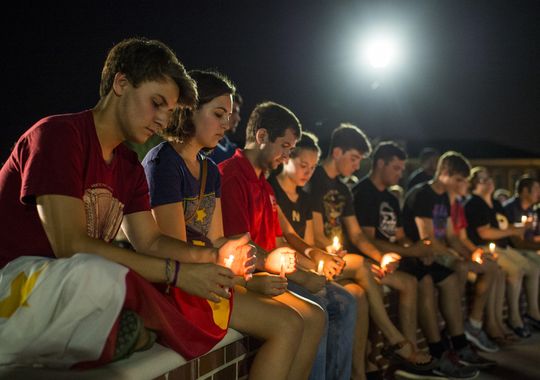
Candlelight vigil, Lafayette, LA

Despite how unfortunately common cancer of every type is, we always look upon someone’s diagnosis as a surprise, something that couldn’t have possibly been anticipated, despite a person’s individual risk factors. For far too long, we’ve treated the risk of gun violence the same way: something unexpected. But gun violence and mass shootings have become anything but a surprise. Spend a few minutes looking at this chart from The Guardian and you will probably realize, as I did, that mass shootings – let alone the many instances where fewer than 4 people are killed or injured – are now so sickeningly common that you probably weren’t aware of most of them. Such violence is now a routine, nearly everyday occurrence, as President Obama reminded us after the violence in Oregon.

Candlelight vigil, Roseburg, OR

Cancer has certainly taught me that death is inevitable, whether from bad decisions or fluke accidents or old age or rogue cells that divide and host intruders. Stuff happens. Yet while my brain tumor wasn’t predictable, many cancers ARE considered preventable, and so we tackle cancer risk, by screening, vaccinating, wearing sunscreen. We put mandatory warning labels on packs of cigarettes and aerosol cans and alcoholic beverages. We acknowledge that there is compelling evidence that certain substances and exposures are more likely to increase the chance of getting cancer.  

Cancer exists in nature and is not a strictly human creation, but we recognize it as a public health risk and devote intensive resources to its prevention. Guns don’t occur organically, and are purely designed and used by humans.  And still we fail to identify them as a public health crisis.

Prayer vigil, Charleston, SC

 Several days before I finished my course of radiation in early January 2011, former US Representative Gabrielle Giffords – we are nearly age peers – was shot in the head as part of a mass shooting that took the lives of six and wounded twenty. A couple of weeks later, I remember watching the nightly news with dear friends at their home in Auckland, talking about the shooting, and realizing with irony how fortunate I was. I only had brain cancer, a function of the great, often baffling mystery of the world. A fellow human didn’t decide to shoot me in the head. Brain cancer had thus far spared my speech and motor skills, unlike what Jared Loughner’s gun had done to Gabby’s brain.

Candlelight vigil, Tucson, AZ

I thought hard about my mortality the night before my brain surgery. It’s a terrifyingly deep well, one I am grateful not to have fallen into yet. Too many others suffer and die violently from guns before they even have the privilege of contemplating their lives.

This is not simply a call to carpe diem and tell people you love them. (Although do that too.) Five years ago and at every subsequent MRI and oncology appointment, friends and family across the globe, from many different cultures and faith traditions, have lifted me up in prayer and demonstrated what is good and unifying in the world. I am ever grateful. But right now, I want to ask for a different kind of support, one that requires more than bowing your head or lighting candles, like the grieving people in these photos attending vigils in the wake of gun violence. Those are good and worthy actions, but rather than simply celebrating my 5-year milestone, please, do something to promote gun control in America.

Call your elected officials. Attend rallies in support of reasonable gun control laws. Donate to one of the many organizations fighting the uphill battle against the NRA and its elected puppets at every level of government, including:

Everytown for Gun Safety/Moms Demand Action (http://everytown.org/)
Americans for Responsible Solutions (http://americansforresponsiblesolutions.org/)
Sandy Hook Promise (http://www.sandyhookpromise.org/)  

And if you think I’m way off base, that gun violence isn’t the issue, mental health is, then for God’s sake, take some action on that. Donate to the National Alliance for the Mentally Ill (https://www.nami.org/) or one of those good organizations in your neck of the woods that serve those with mental health problems.

“Stuff happens,” Jeb Bush told listeners at a campaign event in South Carolina the day after the Oregon shooting. Five years since my diagnosis, and I’ve always shied away from identifying myself as a survivor, perhaps because a good chunk of the tumor still lives in my skull. But I think our collective survival as Americans depends upon reclaiming the narrative about guns.

I am not naïve enough to think that we can eliminate all gun deaths, but I do think we can take reasonable steps – perhaps mandatory background checks and waiting periods for purchasing, a national gun registry, liability insurance for legally purchased guns, and closing purchasing loopholes – to limit angry people from getting and using guns, and in doing so, take our country back from those who have us cowed into submission and inevitable future gun violence. This kind of stuff doesn’t have to happen.
  
[Note: I hadn’t even finished my final draft of this essay – begun on October 1, 2015 after the Umpqua Community College shooting - when I heard the news of yet another mass shooting on October 9, 2015 at another campus, this time Northern Arizona University in Flagstaff, AZ.]

Sunday, December 21, 2014

Winter Solstice 2014


It has been a year of transition, although even saying so sounds cliché. Is there ever a year without transition? 2014 was marked by a false start, to use a running metaphor, apt considering that we were to be in western Kenya this year, one of the world’s running capitals, a place I fell hard for, even as it was almost immediately clear that my job there was all wrong.

The year’s synopsis: I quit a job. I looked for a job. I found a new job. There were growing pains: a farewell to academia; an adjustment to corporate regulations and oversight. My wife left her own business and went back to school. There were growing pains: instructors who didn’t really teach; arbitrary exam questions. Our daughter started her final year of elementary school. There were growing pains: a flight by herself that she was sure she wouldn’t survive; a week of sleepaway camp; plans for middle school. We all survived.

Too often this past year the world itself felt unmoored, like we collectively wouldn’t survive, and I haven’t always been sure, these past months, with gun violence and a literal plague and fear and incivility and racism, how we continue, as a species, to light the candle. 

I just finished Emily St. John Mandel's Station Eleven, a post-apocalyptic novel about how the world forges on after life as we know it has ended, how one can and should find grace and gratitude in everyday life. It is a deeply humane work, and so on this, the longest night, the winter solstice, I want to catalogue some of my many blessings this year. 
  
The homeless man who serenaded me with “Love Me Tender” after a group of us from the Unitarian Church had served dinner to him and his fellow shelter residents. Did we like Elvis? he asked us. Yes, I said. The discovery, last spring, in my regular morning rambles during my months of underemployment, that Northern Flickers had made a nest in a dead tree along the bike path. Finding out I have a Kenyan namesake and knowing that, despite whatever else happened during my long January in Eldoret, I will always be anchored to that place and that little boy.

The botanical gardens at my alma mater, riotous and tropical. The friendly old security guard at the MFA Boston, a Navy vet from WWII, with whom I swapped stories when I sat down to give my blistered feet a break after a job interview. Finding shards of antique pottery on the beach, a robin’s eggshell on a walk. Black raspberry ice cream cones after swimming in the ocean; baby praying mantises hatching in our neglected garden. The wonderful vintage sign I “rescued” from the front yard of a long-abandoned antiques store that now hangs in my den. Meeting my favorite band (Lucero) at the Newport Folk Festival and finding out that they're not just hard-drinking, tattooed womanizers. (Or at least they're really polite ones.) A butterfly bush I “rescued” from a construction site that eventually bloomed in my yard. 

Dahlias. Oh, the dahlias, at the farmers’ market; at our dear ones’ beach house in Weekapaug; for sale, $2 a stem, along a rural road. Stevie Wonder in concert, and singing along to "Sir Duke" with thousands of others. The Georgian doors and fanlights of Dublin. standing on the site where Handel’s “Messiah” was first performed in 1742 and honoring that work by singing a few bars of “O Thou That Tellest Good Tidings to Zion,” my favorite piece from that oratorio.

“O Thou...” is in 6/8 time, and those who know me well are aware that I have an unusual affinity for this time signature, that indeed I can pick it out from the merest background Muzak in a store. That “O Thou” is what I willed myself to hear the rhythm of as I was emerging from anesthesia after brain surgery a little over four years ago, and how, when I could still count it in my head, I knew that I would be okay. Blessings then. Blessings now.

Most of all, the blessings of connection this year. The broad and lovely way that I define family, my parents, my wife and daughter and my daughter’s father and his parents and sisters and my sister and her family and my father-in-law and my brother-in-law and his family. The friends so dear that they are aunties and uncles and cousins to my daughter, family in spirit if not law. The pals from my happy childhood in a close-knit town, many of whom I was able to reminisce with at my 25th high school reunion; my beloved colleagues and students at Brown; my new compatriots at work who crack wise with me; our church communities; the good people at the kung fu studio; the women from Smith who remind me how each one of us is still finding her way; the fellow parents who make us laugh and pinch hit as babysitters and whose families we adore. So many connections, sometimes in person, sometimes epistolary, sometimes only briefly after years, sometimes merely on social media but not, as critics would have it, meaningless. So many beloveds, everyone with their own struggles and moments of clarity. I am grateful for you all.

Merry Christmas, and Happy New Year. Keep lighting the candle.

Namaste,
Kelley

Lyman Plant House, Smith College


Baby Mantis
Pottery shard, robin's egg


"Rescued" sign

Dahlia, Green Animals Topiary Garden


Roadside Dahlias


A Dublin Door


Parents, nephews, daughter


Me and Sis


Me with Ben Nichols (swoon!) of Lucero at Newport

Dad and the girl

Me and the folks


My girls

Dad and Me on his 75th

The girl and her paternal grandparents

The girls and me

My girls and my father-in-law

The dad, the girl


The girl in Dublin